Climbing
Strength and control for climbing.
An example program for someone with no injuries in the last year and no equipment. Your answers in the app shape your own.
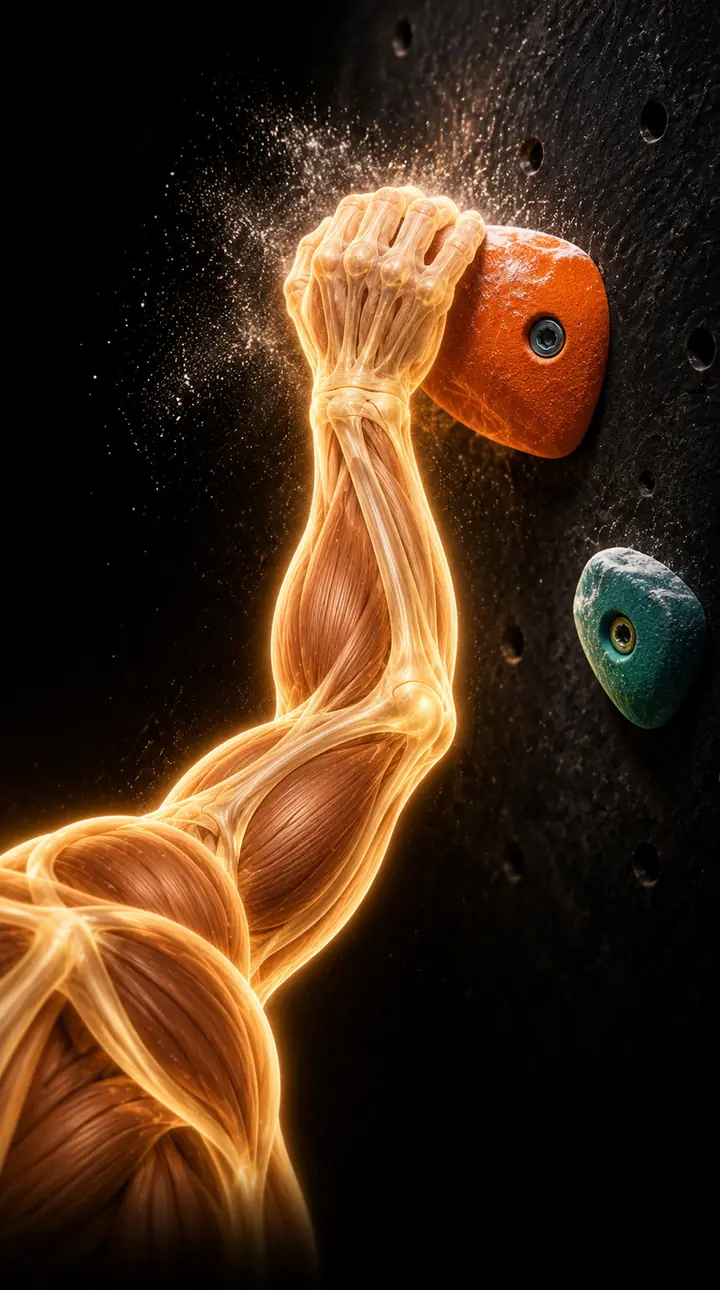
Common climbing injuries
Most climbing injuries are overuse problems in the fingers, shoulders, elbows and wrists. Finger pulley strains are typical, and bouldering falls add ankle and lower body injuries.
What the research says
Research on preventing climbing injuries is limited. A review of adult climbers did not find warm-up habits clearly linked with overuse injury, but one study it included found fewer shoulder and elbow injuries in climbers who did strength training. Reviews across sports also link strength training with fewer injuries. See the sources.
The program
Plus a short warm-up for before you start.
Phase 1 · 4 weeks · 3 sessions a week
Foundation
Build shoulder control and gentle forearm strength.
- Incline Push-Up Plus
- Outward Rotation Hold
+8 more in this phase
Phase 2 · 8 weeks · 3 sessions a week
Build
Build shoulder-blade strength and forearm endurance.
- Incline Push-Up Plus
- Outward Rotation Hold
+9 more in this phase
Sources
- Lauersen et al. Strength training dose in sport: systematic review (BJSM 2018) · 2018
- Andersson et al. Shoulder training in elite handball: cluster randomised trial (BJSM 2017) · 2017
- 2BFit trial protocol · 2008
- Harøy et al. Adductor Strengthening Programme in male football players: randomized trial (BJSM 2019) · 2019
- Prevention of shoulder injuries in throwing athletes, Table 7 and Appendix IV · 2018
- Jeffreys. Warm-up revisited: the RAMP method of optimizing performance preparation (2007) · 2007
- Quarmby et al. Adult climbing overuse-injury review · 2023