Running
Strength and control for running.
An example program for someone with no injuries in the last year and no equipment. Your answers in the app shape your own.
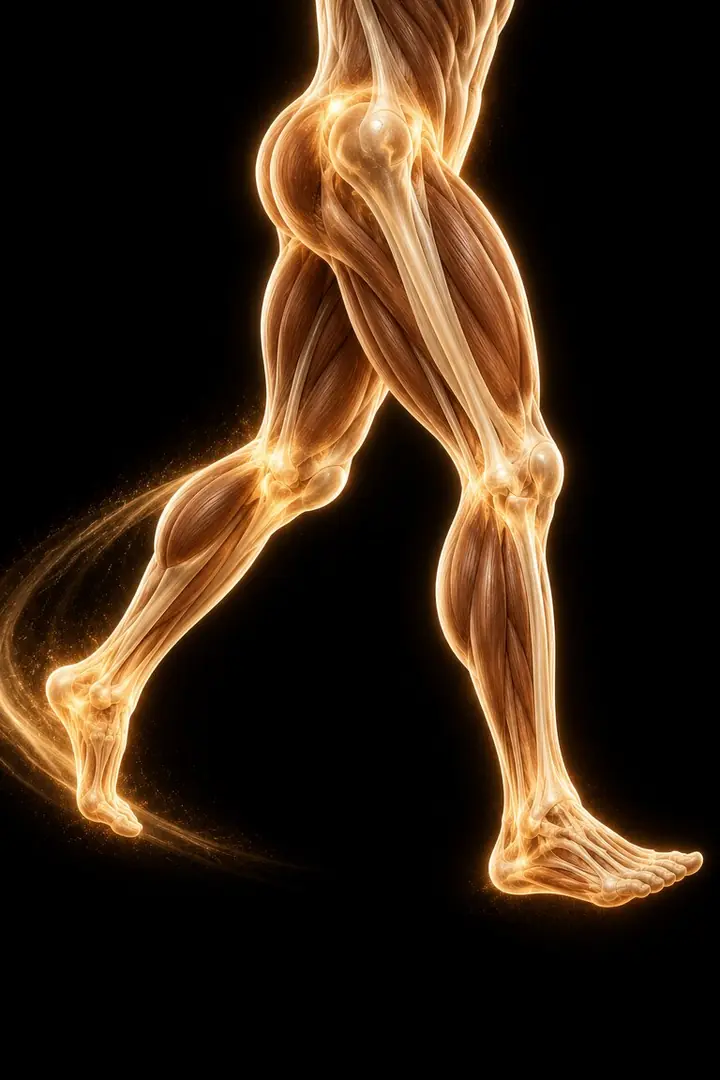
Common running injuries
Most running injuries come from overuse rather than a single accident. The knee is the most common site, followed by the lower leg, ankle and foot, with problems like kneecap pain, shin pain, Achilles pain and heel pain.
What the research says
Research on running injury prevention is less settled than in team sports. One trial found fewer injuries in runners who trained the small muscles of the foot, and reviews across sports link strength training with fewer injuries. See the sources.
The program
Plus a short warm-up for before you start.
Phase 1 · 3 weeks · 3 sessions a week
Foundation
Build controlled leg strength and foot support.
- Supported Split Squat
- Glute Bridge
+6 more in this phase
Phase 2 · 9 weeks · 3 sessions a week
Build
Develop single-leg strength, foot control and quick, springy hops.
- Supported Split Squat
- Single-Leg Glute Bridge
+7 more in this phase
Sources
- Wu et al. Exercise programmes in endurance runners: systematic review and meta-analysis (Sports Med 2024) · 2024
- Taddei et al. Foot core training in runners: randomized trial (AJSM 2020) · 2020
- Kakouris et al. Musculoskeletal health in runners: systematic review (J Sport Health Sci 2021) · 2021
- Leppänen et al. Run RCT (2024) · 2024
- Lauersen et al. Strength training dose in sport: systematic review (BJSM 2018) · 2018
- Matias 2016 Foot-core protocol, Tables S1 and S2 · 2016
- Jeffreys. Warm-up revisited: the RAMP method of optimizing performance preparation (2007) · 2007
- The 11+ Manual: a complete warm-up programme (FIFA) · 2011